
How condensing dehumidification works
13 November 2026Technology9 min read
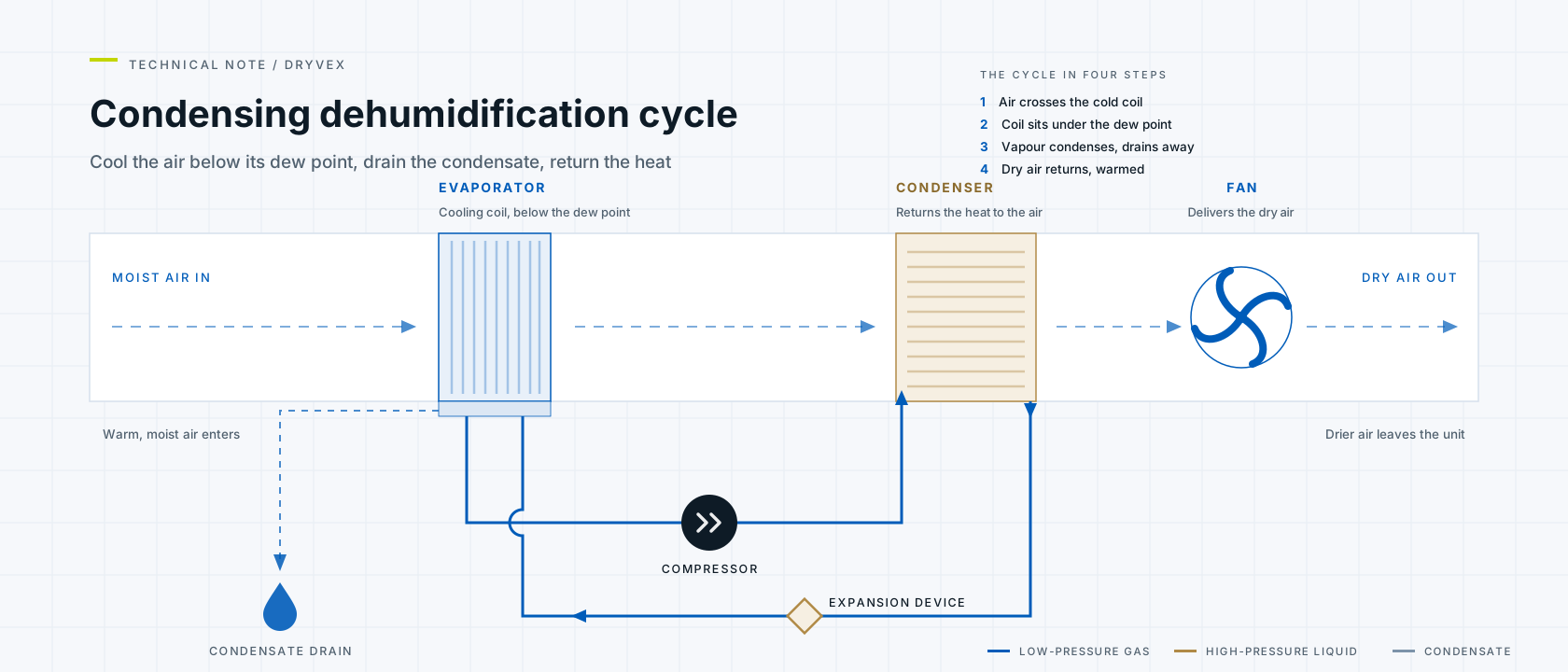
A condensing dehumidifier cools air below its dew point until the vapour leaves. Here is the cycle, its low-temperature limits and the ranges built on it.
A condensing dehumidifier removes water by making the air cold enough that it can no longer carry the vapour it holds. The cold coil does the work; the compressor, fan and drain only support it. That single sentence explains both why the technology is efficient in a warm, wet room and why it loses capacity in a cold one.
In one line: moist air is pulled across a cold evaporator coil, the vapour condenses into droplets that drain away, and the same air, now drier, passes the condenser and returns to the room.
Dew point is the number that decides everything
Relative humidity tells you how full the air is at its present temperature. Dew point tells you the temperature at which it can no longer hold the vapour it is carrying. Cooling air below its dew point is the only way a coil can make water leave, so the coil surface must always run colder than the dew point of the air entering the unit.
That relationship sets the whole design. Air at 30 °C and 60% RH has a dew point near 21 °C, so a coil at 12 °C condenses water easily. Air at 5 °C and 80% RH has a dew point close to 2 °C, so the coil has to run below 2 °C, and below zero it starts to frost. The lower the dew point you ask for, the colder the coil must be, and the less moisture each cubic metre of air gives up as it crosses that coil.
The four steps inside the cabinet
The refrigeration loop behind those steps is the same one used in any chiller: compressor, condenser, expansion device, evaporator. What makes it a dehumidifier rather than a cooler is that the evaporator and condenser sit in the same air stream, so the heat taken out of the air at the cold coil is put back at the warm coil.
- The fan draws moist room air across the evaporator, the cold coil of the refrigeration circuit.
- The coil surface sits below the dew point, so water vapour condenses on the fins instead of passing through.
- Condensate collects in a drain pan and leaves through a gravity pipe or a small lift pump.
- The air, now colder and drier, passes the condenser, picks up the heat the compressor has moved, and returns to the room drier than it arrived.
Why the room does not get cold
The evaporator removes both sensible heat and the latent heat held in the water vapour. The condenser returns the compressor's work to the same air stream, minus what leaves in the condensate and through the cabinet. The net result is air at close to room temperature with a lower dew point, plus a small sensible gain from compressor power.
In practice this means a condensing unit behaves like a mild heater in a cool space and adds a load in an already hot plant room. In air-conditioned rooms the reheat is usually welcome, because the air comes back dry rather than cold and draughty, and no second heat source is needed to keep the room at set point.
Where this principle is the right answer
Efficiency rises with the moisture in the incoming air. Warmer, wetter air gives the coil more vapour to condense for the same fan power, which is why a rated capacity always has to be quoted with the condition it was measured at, such as 30 °C and 80% RH. A unit rated at that condition will not deliver the same litres per day in a 12 °C basement.
- Normal humidity control in occupied or process rooms, typically held between 40% and 65% RH.
- Medium and high temperature environments, roughly 20–35 °C, where the coil can condense a lot of water per unit of air.
- Wet conditions that need a fast pull-down: after wash-down, during the rainy season, or when doors are opened constantly.
- Mature, widely serviced technology with standard refrigerant practice and long component life.
Where it stops: low temperature and low dew point
Below a room temperature of roughly 10–15 °C, the coil has to fall under 0 °C to reach the dew point. Frost builds on the fins, defrost cycles interrupt dehumidification, and useful capacity falls away quickly. Below a dew point of about 5 °C the same limit arrives sooner, and control becomes unstable.
Cold stores, unheated warehouses in winter and dry rooms held under 30% RH at low temperature are therefore not condensing duties. A desiccant rotor removes vapour with a moisture-absorbing wheel and regenerates it with heat, so it never needs a coil below freezing and keeps its capacity as the air gets colder.
The same cycle across the Dryvex range
Every condensing range below uses this evaporator and condenser arrangement. What changes is the coil size, the airflow path and the way the unit is mounted, which is what decides where each one belongs.
- DVC industrial dehumidifiers, 7.5–40 kg/h, ducted or free-blow for production halls, SMT shops and process rooms.
- DVS commercial floor-standing units, 60–158 L/day, for workshops, storage areas and basements where a portable or standing unit fits.
- DVD ceiling dehumidifiers, 30–720 L/day, mounted above the ceiling where floor space cannot be given up, such as car parks and corridors.
- DVX fresh-air dehumidifiers, 138–240 L/day, treating incoming ventilation air before it enters a sealed building.
- DV1680 wall-mounted unit, 168 L/day, where wall space is available and ducting is not.
When the target moves colder or drier
The principle does not change so much as the equipment. Where the room is cold, or the specification asks for a dew point a coil cannot reach, the desiccant rotor range takes over. Where a room has to be held in both directions, a constant temperature and humidity unit combines drying, heating and humidification in one cabinet. Where the problem is dry air rather than wet air, humidification is the duty and ultrasonic units do that job.
What we need to size one
Rated capacity is a curve, not a single number. Two rooms of the same volume with different moisture loads need different models, and the honest answer is sometimes a smaller unit running steadily rather than a larger one switching on and off.
- Room volume or air change rate, and the ceiling height the air actually occupies.
- Entering air temperature and relative humidity at the worst case, not the yearly average.
- Target band and the tolerance the process really needs.
- Fresh air volume and its condition, if the room is ventilated.
- Internal moisture: people, wash-down, open tanks, wet product coming in.
- Drain route, power available, and mounting height for ceiling or wall units.
Does a condensing dehumidifier lower the room temperature?
No, not by itself. It dries the air and returns most of the heat it removed, so the net effect is a small temperature rise rather than cooling. If a room also needs sensible cooling, that is an air-conditioning duty, and the two loads should be sized together rather than expected from one cabinet.