
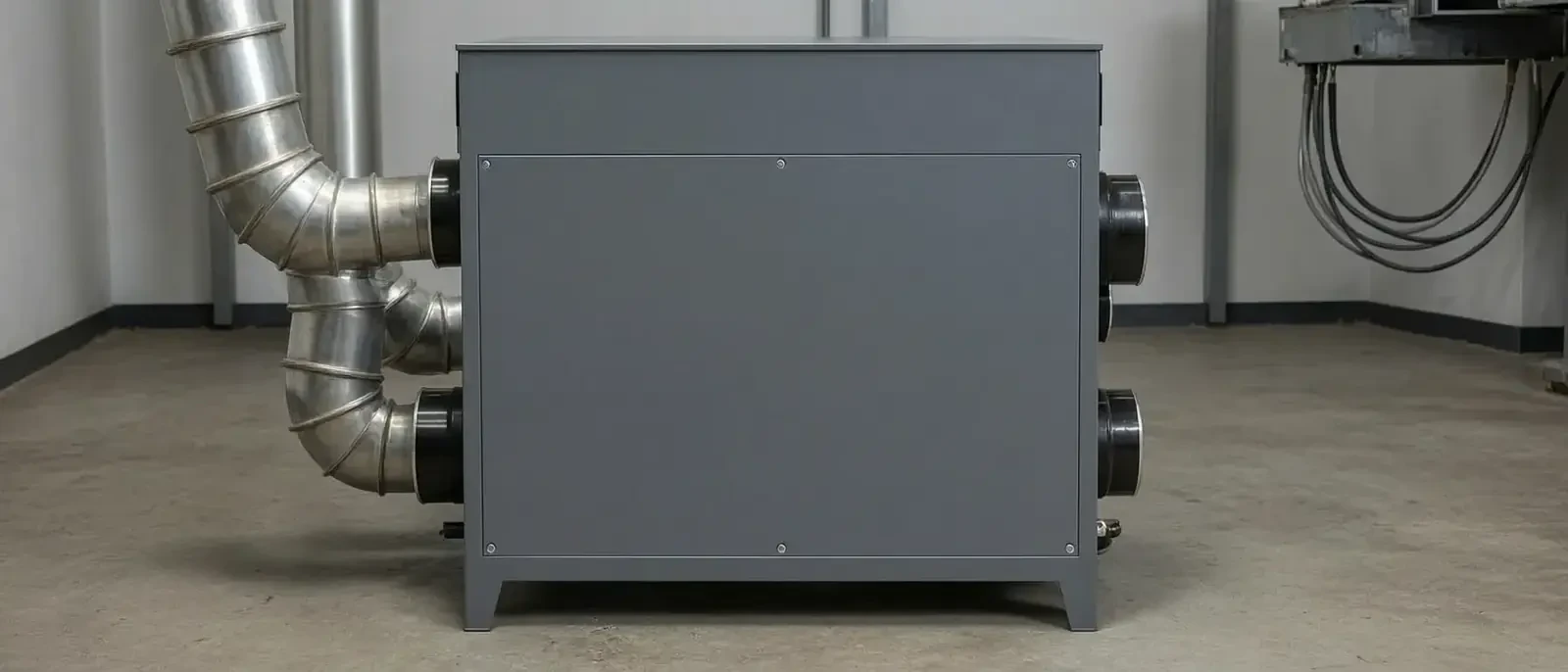
DVR-1500 Desiccant rotor dehumidifier
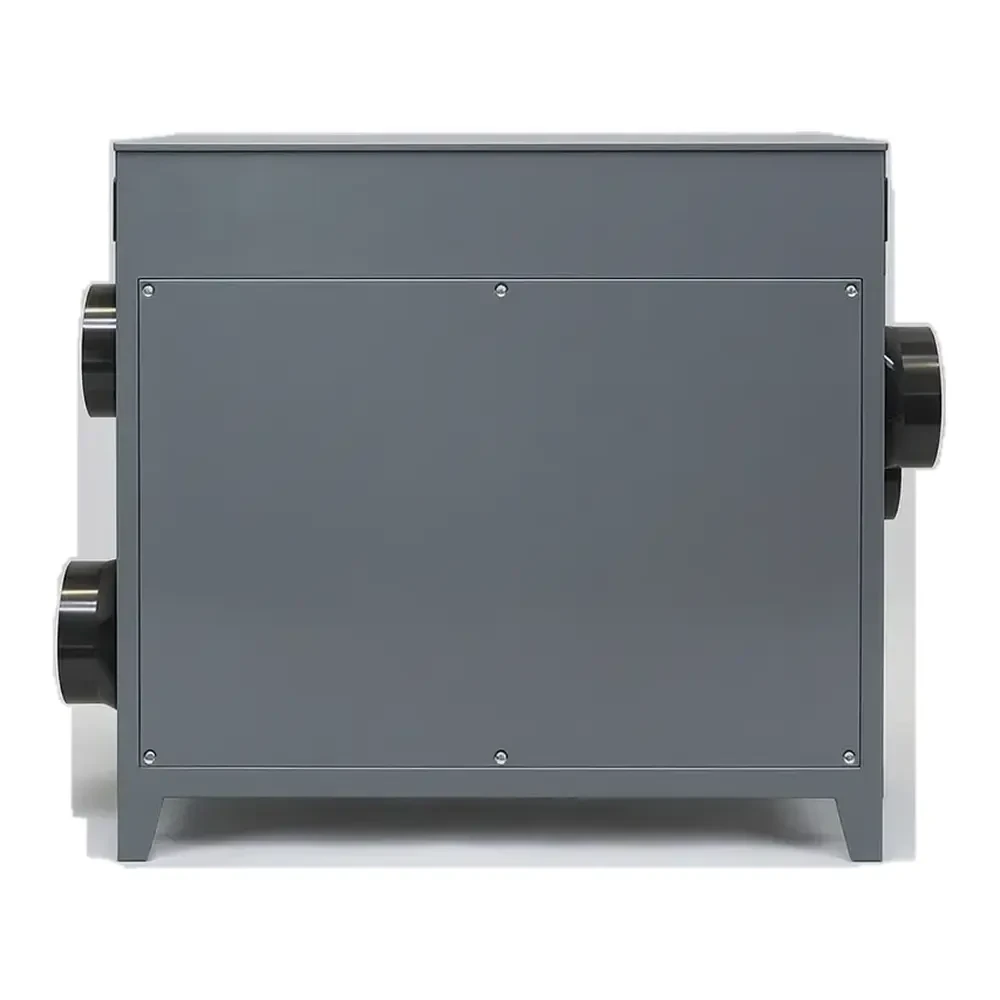
Desiccant rotor dehumidifier
- Silica-gel desiccant rotor for low dew-point drying
- Holds 10–40% RH where condensing units fall short
- Runs from -10 to +45 °C without a defrost shutdown
- No liquid condensate, so no drain pipe is required
Technical specifications
| Model | DVR-1500 |
|---|---|
| Process airflow | 1550 m³/h |
| Regeneration airflow | 550 m³/h |
| Operating power | 18 kW / 27 A |
| Voltage | 380 V / 50 Hz |
| Applied temperature | -10 – +45 °C |
| Body size | 1220 × 685 × 975 mm |
| Weight | 195 kg |
| Noise | < 68 dB |
Values are published catalogue data. Where a site condition differs, the approved drawing for the order takes precedence.
Cabinet photographs of the current series. Grille layout and control arrangement follow the approved drawing for each order.
Low dew-point drying from -10 to +45 °C for cold stores, cold chain and laboratories.
Desiccant rotor dehumidifier 10.2 kg/h belongs to the desiccant rotor dehumidifiers platform. Enquiries are answered within one business day.
Using the DVR-1500
What the rating means
DVR-1500 is rated at 10.2 kg/h, which is about 245 kg, or roughly 245 litres, of water a day. Working figures of that kind are useful in two directions: they convert a moisture load into a model, and they show how much water the drain has to carry away on a wet day.
Catalogue capacity is quoted at a defined test condition, and the accepted figure for an order is the one on the approved drawing. Warmer, wetter entering air gives the coil more water to remove per cubic metre; cooler or drier air gives less. Any model quoted for a project is checked against that condition rather than the headline number.
Installation and air path
Process air passes through the wheel, and the moisture it collects is driven off by heated reactivation air that is then exhausted outside. Ducting for the reactivation stream is therefore part of the installation, and the heat source is part of the running cost.
On this frame, rated noise is < 68 dB.
What to send with an enquiry
- Room volume or air-change rate, with the height the air actually occupies.
- Entering air temperature and relative humidity in the worst week of the year.
- The band that has to be held, and the tolerance the process really needs.
- Fresh-air volume and its condition, where the room is ventilated.
- Internal moisture: people, wash-down, open tanks, wet product coming in.
- Drain route and the power available at the mounting position.
With those answers the model is checked against the moisture load. If the frame is wrong for the room, the reply names the platform that fits instead of pushing this one.
Where this model stops
A rotor removes water but does not cool. Where a room also carries a sensible cooling load, the two duties are sized together rather than expected from one cabinet.
Drawings, electrical data and the installation manual are released with the order, so the site works from the document that matches the frame delivered.
Questions about the DVR-1500
How much room can the DVR-1500 dry?
DVR-1500 is rated at 10.2 kg/h, moving 1550 m³/h. Room size on its own does not settle the model: the load is the air-change rate multiplied by the moisture difference between outdoor air and the band you need, plus whatever the process adds. Send the volume, the air-change rate and the target band and the same calculation comes back with the model and the figure behind it.
How is the DVR-1500 installed?
A reactivation air path ducted to outside, and a heat source for regeneration. On the DVR-1500 the process air passes through the wheel and leaves dry, while the moisture leaves with the heated reactivation stream, which is why two duct routes are part of the installation.
What power supply does the DVR-1500 need?
The supply is confirmed on the order drawing. Cable size and protection follow the installed configuration, so the circuit at the mounting position is checked against the approved drawing rather than against the catalogue page.
How cold a room can the DVR-1500 serve?
The published working range is -10 – +45 °C. A rotor removes vapour without a defrost cycle, so a room colder than a coil can handle is quoted on this platform rather than on a condensing unit.
Is the 10.2 kg/h figure guaranteed on site?
The figure is quoted at a defined test condition. Warmer, wetter entering air gives the coil more water to remove per cubic metre; cooler or drier air gives less. For an order the condition and the required removal rate are written on the approved drawing, which takes precedence over the catalogue figure. Enquiries are answered within one business day.