
Sizing a warehouse dehumidifier from cubic metres and air changes
5 November 2026Selection guide6 min read
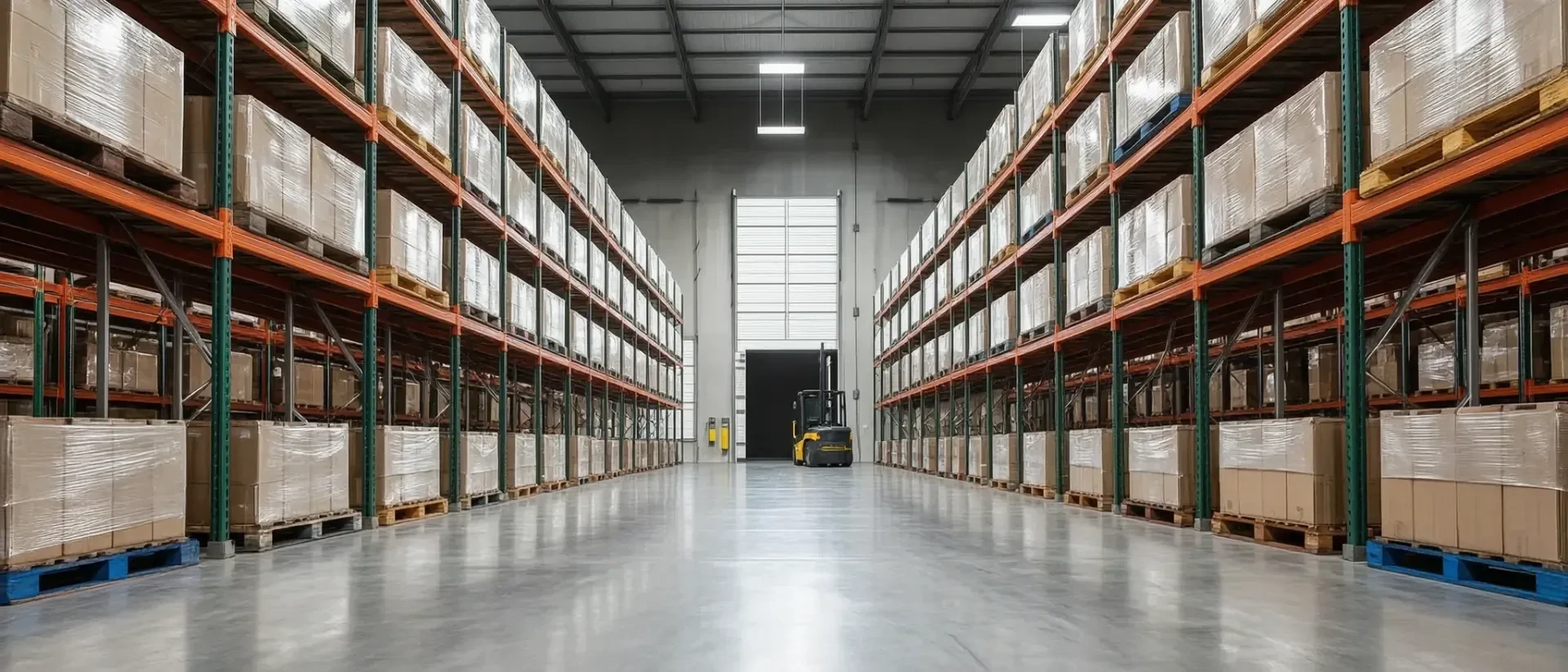
Floor area is the number most warehouse enquiries lead with, and the least useful one. Volume and air changes give the load that the machine actually has to remove.
A warehouse is not a sealed box. Loading doors open, forklifts pass, and the air inside is exchanged with outdoor air many times a day. Each exchange carries water in, and that water is what the dehumidifier has to remove.
Two sheds of the same floor area can therefore need very different machines: the one with eight dock doors and vehicle traffic behaves nothing like the one with a single person door.
From volume to hourly load
Multiply the room volume by the number of air changes per hour to get the volume of outdoor air entering. The difference in moisture content between that air and the target condition, multiplied by the air volume, gives kilograms of water per hour.
Add the moisture from goods brought in from outside, wet floors after cleaning and any process inside the shed. The sum is the load the unit has to cover at the design outdoor condition.
Reading capacity at the right condition
Catalogue figures are quoted at a reference condition, often 30 °C and 80% RH. A warehouse at 15 °C and a 55% RH target asks the coil to work far from that point, and the same machine removes noticeably less water.
The selection sheet should therefore state the design condition, the required removal rate and the margin applied. Without those three numbers, two quotes cannot be compared.
Ducted or free-standing
A free-standing industrial unit works well in an open shed where air can move around the cabinet. Long narrow aisles, high racking and partitioned areas are better served by a ducted ceiling unit that delivers treated air along the run.
Where the shed is large and the target is modest, several smaller units placed along the building often hold the band more evenly than one large machine at one end.