
How to size an industrial dehumidifier from the moisture load
28 October 2026Selection guide6 min read
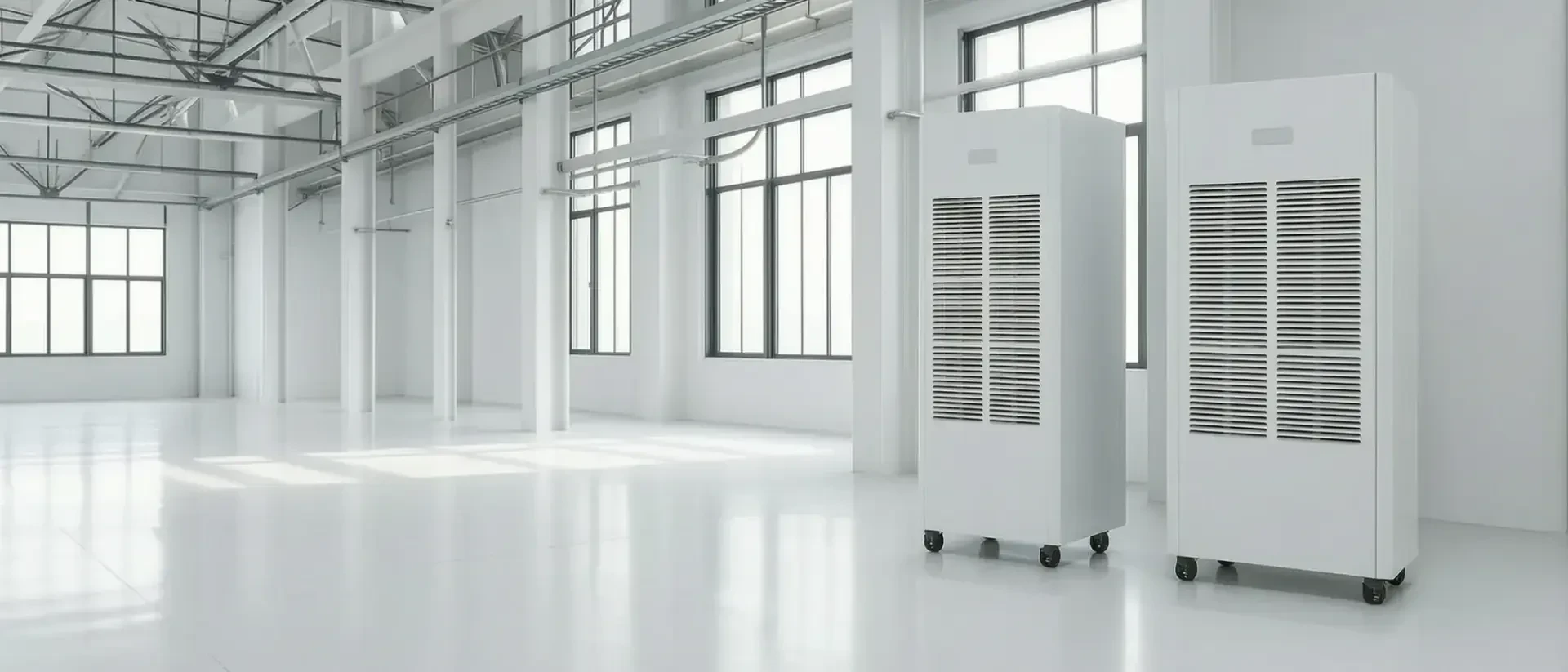
Room volume alone does not decide a dehumidifier. Start from how much water enters the space every hour, then convert that figure into a unit that can remove it at the working condition.
A dehumidifier is sized against a water balance, not against a floor area. Two rooms of the same volume can need very different machines if one has an open loading door, a wet process or a ventilation rate that keeps bringing in humid outdoor air.
The calculation starts by listing every source of moisture in the space and expressing each one in kilograms per hour. Only when that total is known does the machine rating become a technical answer instead of a guess.
What enters the balance
In most industrial enquiries four sources dominate. Each can be estimated from information the buyer already has.
- Air infiltration: door openings, vehicle passages and pressure differences pull outdoor air in. Volume flow multiplied by the moisture difference between outdoor and indoor air gives the load.
- Process moisture: water evaporated in drying, washing, cooking or cooling processes. Product weight loss per batch is often the best available figure.
- People and ventilation: occupancy adds a small but constant load; mechanical fresh air adds a larger one, because the incoming air is treated from outdoor conditions.
- Building fabric: damp slabs, unsealed surfaces and standing water release moisture slowly and continuously.
Converting the load into a model
Catalogues state dehumidification capacity at a reference condition, usually 30 °C and 80% RH. A unit rated at 20 kg/h removes 20 kg of water per hour only at that point; at 20 °C and 60% RH the same machine removes considerably less.
That is why the selection sheet should state the design condition, the required removal rate at that condition, and the margin applied for door openings and part-load running. When a supplier quotes a model without these three numbers, the capacity figure is not yet comparable.
What to send with an enquiry
Room dimensions, the highest and lowest temperature in the space, the target humidity band, the process inside, the number of door openings per hour and whether fresh air is supplied mechanically. With those six items a moisture balance can be prepared and a model proposed with the calculation behind it.