
Condensing or desiccant rotor: choose by dew point, not by price
14 October 2026Technology5 min read
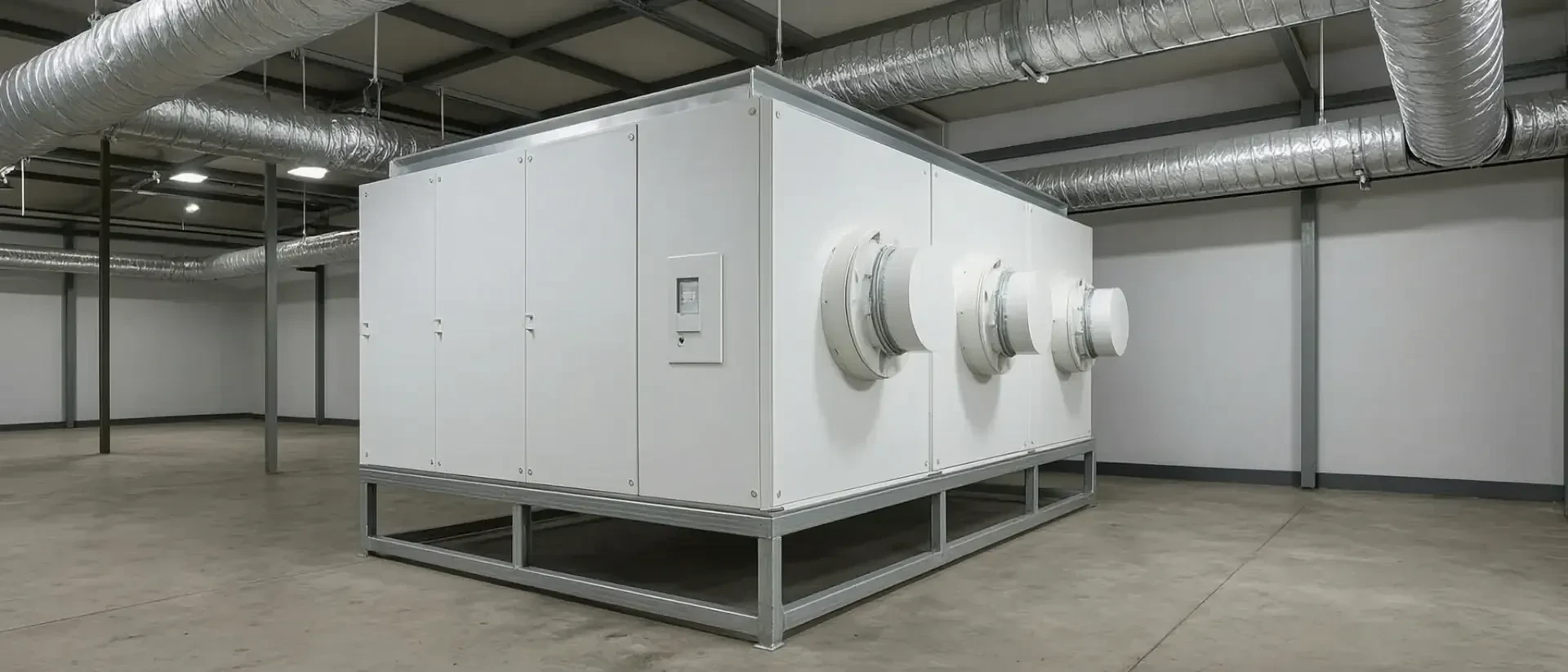
A condensing unit is efficient down to a certain humidity and then falls away. A rotor keeps drying below that point, and runs in cold rooms where coils ice up. The dividing line is the dew point you must hold.
Both platforms remove water from air, but they do it by different means. A condensing unit cools the air below its dew point and drains the condensate. A desiccant rotor passes the air through a silica-gel wheel that adsorbs moisture, then regenerates the wheel with heated air.
The consequence is simple: the condensing unit works best in warm, humid conditions; the rotor works where the target is dry or the room is cold.
Where condensing units stop being economical
As the required relative humidity falls, the evaporator temperature has to fall with it. Below roughly 40–45% RH at normal room temperature the coil surface approaches freezing, defrost cycles take over and the useful output per kilowatt drops.
Below about 20 °C the same effect appears at moderate humidity. In a cold store held at 5 °C a condensing unit spends much of its time defrosting rather than drying.
- Use condensing units for workshops, warehouses and packing halls at 45–65% RH and normal room temperature.
- Consider a rotor when the target is below about 40% RH, or when the room runs below 15 °C.
- Consider a rotor when the process needs a stable dew point rather than a relative humidity band.
What a rotor changes in the design
A rotor needs regeneration heat, either from an electric heater or from steam or hot water, and it needs a regeneration air path to carry the moisture away. That means two duct routes instead of one and a higher connected load.
In exchange there is no condensate to drain, no defrost interruption, and operation continues from -10 °C to +45 °C. For cold chain, lithium battery dry rooms, laboratories and seed storage that trade is usually worth making.
A practical test
Write down the humidity you must hold, the lowest temperature in the room, and whether a drain is available. If the answer is below 40% RH, below 15 °C, or no drain, the rotor is the platform to price first.